患者はどの健康リスクをどのくらい重要と考えているか~構造化された評価からみる健康リスクの患者自身が選ぶ項目と優先度~

―文献名―
Phillips SM,at el.Frequency and prioritization of patient health risks from a structured health risk assessment.Ann Fam Med. 2014 Nov-Dec;12(6):505-13.

―この文献を選んだ背景―
 我々は日々時間がない中で外来診療をしているが、なかなか行動変容にまで結びつけることができないで不全感を抱いてはいないだろうか?効率よくアプローチする手段はないだろうか?今回、それに関するアイデアの一つとなりうる論文を紹介したい。

―要約―
【目的】
 頻度と患者が記述した変化への受け入れを記述し、プライマリケアでの13の健康リスク因子の重要性を議論すること。

【方法】
 9つのプライマリケア診療所の患者1707人がMOHR(My Own Health Report)  trialの一環でgeneral(一般的な)、behavioral(行動上の)、psychosocial(心理社会的な)リスク因子を報告した。BMI、健康の状態、食事、身体活動、睡眠、薬物使用、ストレス、不安または心配、抑うつである。我々はそれぞれの回答をat riskかhealthyに分類した。また、患者が変化するための準備ができているか、かつ/もしくは、ケア提供者と同定されたリスク因子について議論したいと思っているかを示した。患者が最も重要と考えている変える備えがあるリスク因子を1つ選んでもらった。因子ごとや因子間の回答された頻度の解析や患者背景ごとや施設間での多様性を検討した。

【結果】
 患者は平均5.8個(SD=2.12;rage,0-13)の不健康な行動と心理的なリスク因子を持っていた。約55%の患者が6個以上リスク因子を有していた。患者は1.2個について変えたいと考えており、0.7個議論したいと考えていた。最も一般的なリスク因子は不適切な「果物/野菜摂取」(84.5%)、「過体重/肥満」(79.6%)であった。患者は「BMI」を改善したいと考えている人が最も多く(33%)、次いで「抑うつ」(30.7%)であり、議論したがってたのは「抑うつ」(41.9%)、「不安、もしくは心配」(35.2%)であった。結論として、患者は最も重要視していたのは「健康状態」であった。

【結論】
 プライマリケアにおけるルーチンの包括的健康リスク評価でおそらく行動と心理社会的な健康リスクの多くを同定できる。患者の優先度を確認することによって、ケア提供者と患者とが診療をより良くマネジメントでき、行動変容につなげていけるものと考える。

【限界】
 ・ランダム化されていない。一般化可能性も限界がある。(様々な診療圏、患者規模など診療所選択には
  配慮しているが)
 ・その後、医師などへ情報が行き、ケアに活かされるなどの流れが十分患者に伝わっておらず、回答が
  不十分になった可能性がある。
 ・既往歴、通院歴、患者医師関係などを確認していない。
 ・横断研究であるが故、日々の生活を含んだコンテクストや患者医師関係等のリスクを把握できて
  いない。 
 ・時間変化、最終的なMOHRを用いた結果を評価できていない。
 ・リスクの数が多すぎた可能性がある。

―考察とディスカッション―
 家庭医の外来は扱うプロブレムの多さもあり十分な時間はない。その中で患者の関心事、潜在的な問題にしっかりと効率よくアプローチする必要性は大きい。今回、この文献では彼らが健康リスクと考えている事項をピックアップすることができ、かつ改善したいと考えているリスクや、医療者と相談したいと考えているリスクが浮き彫りになった。これは米国の研究であり、全てを目の前の患者にあてはめることは難しいが、一考に値する。また、これらの質問を診療所だけで施行し、介入を行うだけではなく、保健師や他の団体と協力しながら活用することも考えると良いと思われる。

 みなさんならこの情報をどのように活用できそうですか?

【開催日】
2015年7月22日(水)

過去の食環境・経験が現在・未来の食生活へ及ぼす影響

―文献名―
小林 敬子 (日本女子体育大学).去の食に関する環境および体験が 現在および未来の食生活に及ぼす影響.校保健研究 45 ;2003;200-217

―要約―
目的:
過去の食に関する環境および体験が現在の食習慣や未来の家庭的食事に対する意識に与える影響を明らかにする

セッティング:
2002年10-11月
東京都内の私立女子大学

対象:
女子大生(2・3年生) 187名

方法:
 集合調査票を用い、上記対象者に調査用紙に無記名で解答を依頼。
 質問は、過去における食に関する環境および体験、現在における食に関する習慣、未来における家庭的食事に対する意識について、それぞれ16項目・10項目・5項目を実施。
 その結果を用い、上記3つの因果関係を用いて検証した。

結果:
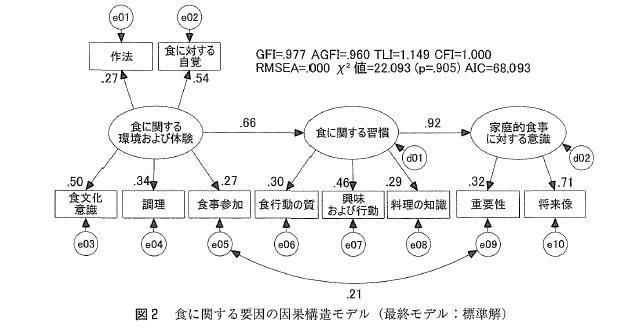
 食に関する要因の因子分析結果を考慮して要因ごとに抽出された因子を説明する質問項目を因子ごとに合成し、過去における食に関する環境及び体験を説明する5項目、現在における食に関する習慣を説明する3項目、未来における家庭的食事に対する意識を説明する2項目の計10項目を用いて分析を行った。その結果採択された因果構造モデルにおいて、過去における食に関する環境及び体験から、現在における食に関する習慣へのパス係数は0.66、現在における食に関する習慣から、未来における家庭的食事に対する意識へのパス係数は0.92と中等度から高い値を示した。
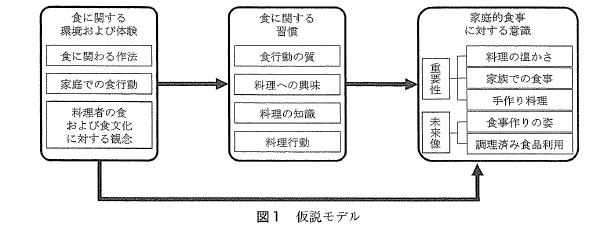
図1:仮説モデル
 150115_1

図2:因果構造モデル 表示
150115_2

結論:
過去における食に関する環境および体験は現在の食に関する習慣に影響を及ぼし、現在の食に関する習慣は現在および未来における家庭的食事に対する意識に影響 を及ぼす。
また過去における食に関する環境および体験は現在および未来における家庭的食事に対する意識には直接的ではなく、現在の食に関する習慣 を介在 し、間接的に影響 している。

【開催日】
2015年1月14日(水)

適度な飲酒のリスクについて

―文献名―
Association between alcohol and cardiovascular disease: Mendelian randomisation analysis based on individual participant data. BMJ 2014;349:g4164 doi: 10.1136/bmj.g4164

―要約―
飲酒は様々な病気に関係することが知られている。非飲酒者と少量~中等量の飲酒者の比較観察研究で飲酒者の心血管リスクが低いことが示されていることから、適度な飲酒は心血管や脳卒中のリスクを下げると言われてきた。しかし、非飲酒群には健康状態が悪い、生活習慣、社会的因子のために飲酒できない人も含まれていると考えられる。これまでの研究でこのような交絡因子の影響を排除できていない。しかし飲酒と心血管リスクの関係を調べるRCTの実施は困難で行なわれていない。
今回、全く飲酒できない、または少量しか飲酒できない遺伝的多型を有する人とそうでない人を対象としてメンデルランダム化メタアナリシスを行なった。病歴の影響は受けないことから、交絡因子の候補の影響を小さくできると考えた。

対象:
アルコールデヒドロゲナーゼ1B(ADH1B)遺伝子の一塩基多型(rs1229984)を有する人と有さない人。(rs1229984の保有者は飲酒量が少ない。)
56件の疫学研究の261991人を分析、平均年齢58歳(26-75歳)女性が48%
心血管イベントは20259件、脳卒中10164件、2型糖尿病は14549件報告されていた。

主要アウトカム:
冠動脈疾患の罹患率と脳卒中
ADH1Brs1229984保有者と飲酒量で層別化

 ADH1Brs1229984Aアレル保有者における1週間の飲酒量(ユニットで換算)は、この多型を持たない人々に比べて17.2%(95%信頼区間15.6-18.9)少なく、大量飲酒する可能性は低く(オッズ比0.78、0.73-0.84)、禁酒していると自己申告する可能性が高かった(オッズ比1.27、1.21-1.34)。また、γGTP値も低かった(-1.8%、-3.4から-0.3)。
rs1229984Aアレル保有者の収縮期血圧は非保有者に比べて有意に低く(-0.88mmHg、-1.19から-0.56)、インターロイキン-6値は低く(対数変換した値の平均差は-5.2%、-7.8から-2.4)、腹囲は細く(-0.34cm、-0.59から-0.10)、BMIは低かった(-0.17、-0.24から-0.10)。HDLコレステロール値には、アレル保有者と非保有者の間に有意差は見られなかった。
rs1229984Aアレル保有者の冠疾患リスクは非保有者より低かった(オッズ比0.90、0.84-0.96)が、分析対象を非飲酒者に限定すると多型の影響は見られず、あらゆる飲酒者ではオッズ比は0.86(0.78-0.94)となった。飲酒量で層別化してもオッズ比に有意差は見られなかった(P=0.83)。
虚血性脳卒中リスクはrs1229984Aアレル保有者で低かった(オッズ比0.83、0.72-0.95)。

飲酒量が少なくなる遺伝子多型を保有する人々は、これを持たない人々に比べて心血管危険因子のプロファイルが良好で、冠動脈疾患リスクと虚血性脳卒中リスクは低かった。結果からは、飲酒量が少ない人々でも、さらに飲酒量を減らせば心血管リスクは低下することを示唆している。そのため適度な飲酒は心血管リスクを下げるという概念に疑問を呈すと著者は述べている。

【開催日】
2014年12月3日(水)

果物、野菜の消費量と死亡率の関係

―文献名―
Fruit and vegetable consumption and mortality from all causes, cardiovascular disease, and cancer: systematic review and dose-response meta-analysis of prospective cohort studies. BMJ. 2014 Jul 29;349:g4490.

―要約―
【背景】
果物や野菜の消費量を増やすと、心血管疾患やがんによる死亡リスクが低下することを示すエビデンスが増えている。しかし、結果は必ずしも一致していない。

【分析対象】
前向きコホート(全ての原因、心血管、癌での果物と野菜の消費量のレベルで死亡のリスクを推定した)

【結果】
16のコホート研究がこのメタ分析に適していた。4.6-26年のフォローアップ期間中、833234人の参加者の中で56423人が死亡(心血管11512人、癌16817人)を含む。果物や野菜の高い消費が全死因の死亡リスクの低さと関連していた。全死因における死亡率のプールハザード比は、1日1盛り(1皿)の果物と野菜の増加で0.95 (95%信頼区間0.92-0.98、P=0.001)、果物だけで0.94(95%信頼区間0.90-0.98、P=0.002)、野菜で0.95(95%信頼区間0.92-0.99、P=0.006)。敷居値は5盛り(5皿)の果物と野菜で、その後は全ての原因の死亡のリスクは下がらなかった。心血管死亡率は有意な逆相関が見られたが(1日に果物と野菜のそれぞれを追加したハザード比は0.96、95%信頼区間0.92-0.99)、一方で癌の死亡リスクは果物や野菜の消費量が高くても関連はなかった。※ 1盛り:野菜77g   果物80g

全死因による平均死亡リスクは、1日の果物や野菜消費量が1皿増えると5%低下し、心血管死のリスクは果物や野菜が1皿増えるごとに4%減少。

【考察・結論】
研究チームは「適切な量の果物や野菜を食べるアドバイスを提案するだけではなく、肥満・運動不足・喫煙・アルコール摂取量の多さががんのリスクに与える悪影響をさらに強調すべきだ」と示唆している。本研究結果は、健康と長寿を促進するために果物や野菜の消費を高める現在の勧告を支持するものである。

【開催日】
2014年8月20日(水)

肥満成人の非外科的介入での長期間の減量の維持

―文献名―
Long term maintenance of weight loss with non-surgical interventions in obese adults: systematic review and meta-analyses of randomised controlled trials. BMJ 2014;348:g2646 doi: 10.1136/bmj.g2646 (Published 14 May 2014)

―要約―
【目的】
肥満成人患者の減量の維持をサポートする方法を系統立ててレビューする
これらの介入の効果に対するエビデンスを評価する

【デザイン】
Systematic review with meta-analysis

【情報源】
Medline, PsycINFO, Embase, and the Cochrane Central Register of Controlled Trials.

【研究の選択】
研究は2014年1月まで確認されたもの。18歳以上の成人肥満で減量を維持するための介入を行い、5%以上の減量をフォローアップ期間の12ヶ月以上の長期間維持するという無作為試験

【研究データの評価と統合】
複数研究者が独立して、それぞれ研究を選別した。
研究の特徴、アウトカムが抜き出された。
Meta-analyses:分散逆数重み付け法と変量効果モデルを用いて、減量維持の介入効果を見積もった。
結果は95%信頼区間で体重の変化の平均値で表現された。

【結果】
45の研究に7,788人参加
食事、運動の両方に焦点をあてた行動療法の介入では、12ヶ月後に体重がコントロール群と比較して−1.56kgの平均値の差があった。
行動療法にオルリスタットを組み合わせて介入すると、12ヶ月後、プラセボと比較して−1.80kgの差が出た。しかし、すべてのオルリスタット研究群はプラセボ群と比較して高頻度で胃腸障害の副作用が出現した。オルリスタットの容量依存性も示された。120mgを1日3回投与した群(−2.34 kg, 95%信頼区間:−3.03 to −1.65)は、60mg、30mg投与群(−0.70 kg, 95%信頼区間:−1.92 to 0.52), P=0.02と比較してより高い減量維持効果がみられた。

【結論】
食事と運動の両方に焦点をあてた行動療法の介入は減量維持に対して、小さいが、重要な効果があることが示された。

【開催日】
2014年7月23日(水)

ヘルスメンテナンスは必要か?

―文献名―
Lasse T Krogsbøll, Karsten Juhl Jørgensen, Christian Grønhøj Larsen et al.General health checks in adults for reducing morbidity and mortality from disease: Cochrane systematic review and meta-analysis.BMJ 2012;345:e7191

―この文献を選んだ背景―
2014年6月のBMJの、「Effect of screening and lifestyle counselling on incidence of ischaemic heart disease in general population: Inter99 randomized trial」という研究では、「一般市民に対する基本的なカウンセリングや生活指導は、心血管イベントの予防において何の効果もなかった」と結論づけられた。家庭医は、風邪で来院した患者にも、禁煙の取り組みをすすめたり、高血圧のスクリーニングを行なったりして生活介入する場面が多いが、こうした行為自体の意義を考える時期に来ているかもしれない。今回、血圧測定や血液検査といった、スクリーニングについて否定的な見解を示すコクラン・システマティック・レビューを把握し、改めてヘルスメンテナンス、健康増進について深める機会にしたいと考えたため。

―要約―
【目的】
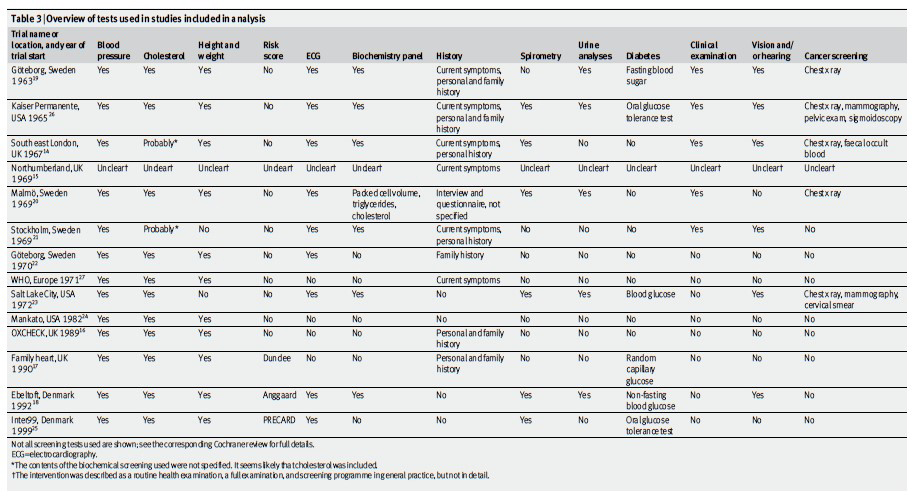
主に、代理アウトカムよりも、合併症発症率や死亡率に注目して、一般的な成人に対する健康チェック(table3参照:血圧測定、血液検査、心電図検査など)の効果と弊害を評価する。
PICO
P:高齢者を除く成人(特に病気やリスク要因で選別していない)
I:健康チェックした群
C:健康チェックしなかった群
O:死亡率、合併症で違いがあるか

【方法】
・デザイン
 コクラン・システマティック・レビューとメタアナリシスである。死亡率については、変量効果モデルを用いて解析し、他のアウトカムについては、質的統合を行なった。
・データベース
MEDLINE EMBASE CENTRAL、CINAHL, EPOC register, ClinicalTrials.gov, and WHO ICTRP, supplemented by manual searches of reference lists of included studies, citation tracking (Web of Knowledge), and contacts with trialists
・データ抽出
2人の観察者が独立して、適応、抽出されたデータ、バイアスリスクを評価した。必要時には著者にも連絡をとった。

【結果】
今回の研究に合致するスタディが16件あり14件が利用できるデータであった(182880人の参加)。9件の試験が総死亡率について分析しており、相対リスクは、0.99(95%CI 0.95−1.03)であった。8件の試験において、心血管イベントによる死亡率について分析されており、相対リスクは1.03(95%CI 0.91−1.17)であった。また、8件の試験において、癌死における死亡率が分析されており、相対リスクは1.01(95%CI 0.92−1.12)であった。サブグループ解析、感度分析を行なっても、この結果は変わらなかった。一般的な健康チェックで、死亡率、入院率、機能不全、患者の心配、他院受診、欠勤などにおいて、何の効果もなかった。ただ、全ての試験においてこれらのアウトカムには言及されてはいない。1件の試験では、健康チェックをした群では、6年以上の追跡の中で、コントロール群に比較して、新しい診断名が20%増加しており、慢性疾患の状態を自己報告する患者の数が増えた。また1件の試験では、健康チェック群では、コントロール群と比較し、高血圧と高脂血症の有病率が増えたとしている。

140618

【結論】
一般的な健康チェックは合併症を減少させず、総死亡、心血管イベントによる死亡、癌死においても死亡率を下げる事はなかった。ヘルスチェックによって新たな診断名のついた患者が増えた。重大で害のある結果については、研究されていない、または言及されていないことが多かった。

―考察とディスカッション―
自身のプラクティスとして、米国予防医学専門委員会(USPSTF)のスクリーニング項目を参考に、健康増進を考えることが多い。今回の論文では、ヘルスチェックをされた時期が1970年代であり時代遅れであったり、介入方法、アウトカム設定がバラバラでフォロー期間も短いという点から、現在とマッチしていない可能性もあり限界もある。ただ、全体として、ヘルスチェックを行った場合に、あまり効果がないという結果や、Inter99といった現代的な手法でも、心血管イベントに対して、予防的な意味がないという結果を受けて、比較的高い妥当性がありそうな、「禁煙」に力を注ぐだけでいいとも考えられた。高齢者を除いた成人のヘルスメンテナンス、皆様ならどう考えられますか?

【開催日】
2014年6月18日(水)

禁煙後のメンタルの変化(システマティックレビューとメタ解析)

― 文献名 ―
Gemma Taylor,et al:Change in mental health after
smoking cessation: systematic review and meta-analysis.BMJ 2014;348 doi

― 要約 ―
【Objectives】 禁煙を続けた場合と比較して禁煙をした後でメンタルにおける変化を調査すること。

【Design】systematic reviewとmeta-analysis

【Date sources】
2012年4月までの関連した研究を以下から検索(Web of Science, Cochrane Central Register of Controlled Trials, Medline, Embase, and PsycINFO)。文献に含まれるreferenceリストから手作業で検索し、データが不十分であれば直接研究者に連絡を取った。検索ワードは”mental health,” “smoking cessation,” “smoking reductionの組み合わせ。

【Eligibility criteria】
・population:一般集団か何らかの臨床診断がついた集団の喫煙者
 ・Exposure:研究期間中に喫煙継続か禁煙をすること
 ・Outcome:禁煙前と禁煙後6週間以上経過した後のメンタルヘルスを測定
 ・Language:言語による除外なし
・ Study design:longitudinal studyのみ(RCTとコホート)

【Results】
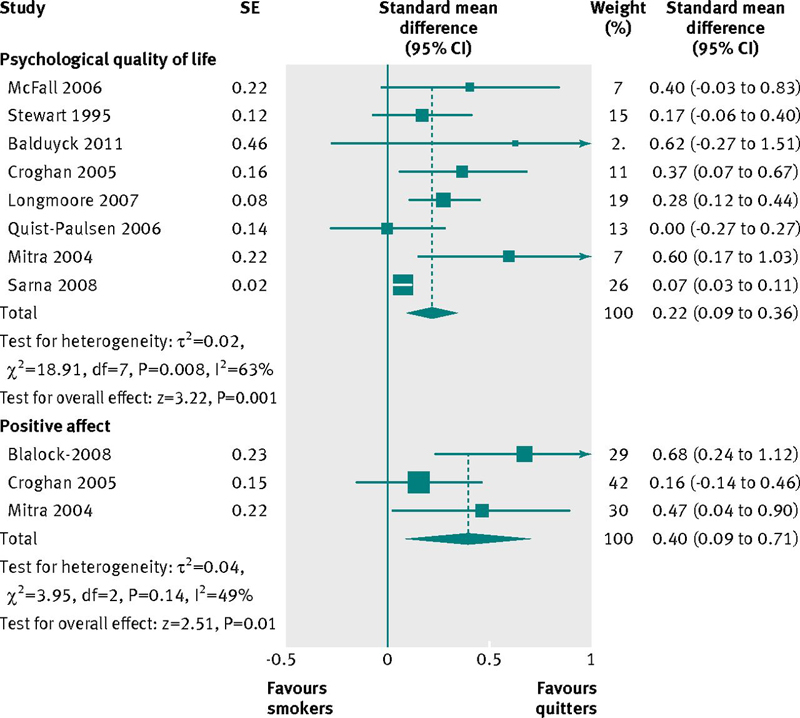
不安、うつ、不安とうつの混合、精神的QOL、ポジティブな感情、ストレスを測定するようにデザインされた質問紙にてメンタルヘルスを評価した26個の研究が対象となった。フォローアップ期間は、7週間から9年間であった。不安、うつ、不安とうつの混合、ストレスは喫煙者に比べ、禁煙者において有意に減少した。標準化した平均で不安 −0.37 (95% confidence interval −0.70 to −0.03); うつ −0.25 (−0.37 to −0.12); 不安とうつの混合 −0.31 (−0.47 to −0.14); ストレス −0.27 (−0.40 to −0.13)であった。精神的QOL、ポジティブな感情ではその逆で喫煙継続車に比べ、禁煙者において有意に改善した。精神的QOL0.22 (0.09 to 0.36); ポジティブな感情0.40 (0.09 to 0.71)となった。一般集団と身体疾患、精神疾患を持った集団とで効果の大きさには違いがなかった。

140305

【Conclusions】
禁煙は不安、うつ、不安とうつの混合、ストレスの改善と関連し、ポジティブな感情とQOLの改善と関連した。効果の大きさは精神疾患を持った集団とそうでない集団で同等であった。この効果の大きさは、気分障害、不安障害患者に抗うつ剤を処方した時の効果と等しいか、それ以上のものであった。

<参考>
 軽症~重症のうつ病患者へのSSRI治療 
−0.17 to −0.11
34個のRCTのメタアナリシスで全般性不安障害患者への抗うつ剤治療 
−0.23 (−0.43 to −0.13)から−0.50 (−0.77 to −0.23)

― 考察とディスカッション ―

①多くの喫煙者はタバコを吸うと落ち着く、気が紛れるため、無くてはならないものだと言う。しかし、本研究では禁煙するほうがむしろポジティブな結果を得られるということであり、今後の有用な情報であった。

②今までうつや不安障害などの精神疾患を有した患者には、禁煙自体が精神的症状の増悪を引き起こすことへの心配があった。しかし、本研究によってこれらの患者でも、ある程度の期間を経たら(今回は6週間以上)、プラスに作用することが分かったため、禁煙指導の対象者や目的が広がったのではなかろうか?

③ただし、本研究は観察研究も含まれるため、因果を証明するには不十分である点にも注意が必要である。

開催日:平成26年3月5日

アメリカ男性の朝食摂取と冠動脈疾患の危険性についての前向き研究

- 文献名 -
 Prospective Study of Breakfast Eating and Incident Coronary Heart Disease in a Cohort of Male US Health Professionals Leah E. Cahill,  et. al. Circulation. 2013; 128: 337-343

- 要約 -

【背景】
 成人において、食事をスキップすることは、体重増加、高血圧、インスリン抵抗性、空腹時脂質濃度上昇と関連する。しかしながら、食事内容にかかわらず、特定の食習慣が冠動脈疾患(心筋梗塞や狭心症)のリスクに影響するかどうかは分かっていない。本研究の目的は、食生活と冠動脈疾患のリスクを前向きに検討すること。

【方法と結果】
 朝食を食べることを含む食習慣について、1992年に45歳から82歳のアメリカ人男性26,902人を評価した。彼らは、Health Professionals Follow-up Study に参加しており、心血管系疾患や悪性腫瘍には罹患していなかった。フォローアップの16年間に、1527もの冠動脈疾患発症が診断された。 人口統計、食事、ライフスタイルで調整した冠動脈疾患、およびその他の冠動脈疾患の危険因子の相対リスクおよび95%信頼区間を推定するためにCox比例ハザードモデルを使用した。朝食をスキップした男性は、スキップしなかった男性に比べて27%高い冠動脈疾患発症のリスクを有していた(95%信頼区間1.06~1.53、相対リスク1.27)。夜遅くに食べない人に比し、夜遅くに食べる人は55%高い冠動脈疾患発症のリスクを有していた(95%信頼区間1.05~2.29、相対リスク1.55)。これらの関連は、BMI、高血圧、高コレステロール血症および糖尿病の影響を受けていた。食べる頻度(一日あたりの食べる回数)と冠動脈疾患の危険性との間には有意な関連は認められなかった。

【結論】 
 健康の専門家の男性のこのコホートでは、朝食を食べることは、冠動脈疾患のリスク低下と有意に関連していた。

開催日:平成25年12月4日

Short-Term and Long-Term Health Risks of Nuclear-Power-Plants Accidents

― 文献名 ―
 John P. Christodouleas, M.D., M.P.H., Robert D. Forrest, C.H.P., Christopher G. Ainsley, Ph.D., Zelig Tochner, M.D., Stephen M. Hahn, M.D., and Eli Glatstein, M.D. N Engl J Med 2011; 364:2334-2341

 ― この文献を選んだ背景 ―
 Many foreigners asked me about Fukushima nuclear accident when I attended in WONCA 2013 in june this year. Their questions were mainly about the present situation, risks of health problems, contamination of seawater, and what we are doing for the situation. To none of them, I couldn’t answer clearly. It is true that we don’t have enough information about this problem, but I realize that I must learn more about this problem as a health care provider, and as a Japanese.

 ― 要約 ―
MECHANISMS OF EXPOSURE

Reactor Accidents and the Release of Radioactive Materials


In the event of an accident, the primary concern is that the support structure (core) containing the fuel and the fission products may become damaged and allow radioactive elements to escape into the environment. When the core cooling system damaged, the reactor core and even the fuel itself can partially or completely melt, which results in explosions within the reactor, dispersing radioactive material.

In the partial meltdown at Three Mile Island, a minimal amount of radiation was released, has not yet led to identifiable health effects. On the other hand, in Chernobyl, the explosions and the subsequent fire sent a giant plume of radioactive material into the atmosphere, resulted in 28 deaths related to radiation exposure in the year after the accident. The situation at Fukushima will probably end up ranking between these two historical accidents in terms of radiation releases and health consequences.

Types of Radiation Exposure

Human radiation exposure as a result of reactor accidents is generally characterized in three ways: total or partial body exposure as a result of close proximity to a radiation source, external contamination, and internal contamination. Internal contamination occurs when fission products are ingested or inhaled or enter the body through open wounds. This is the primary mechanism through which large populations around a reactor accident can be exposed to radiation. 
Reactor accidents can release a variety of radioisotopes into the environment. The health threat from each radioisotope depends on an assortment of factors ( e.g., half-life , gaseous, substantial quantities , tendency to settle on the ground) . The release of radioactive water into the sea at the Fukushima plant has resulted in an additional route whereby the food chain may be affected, through contaminated seafood.

CLINICAL CONSEQUENCES OF RADIATION EXPOSURE


Type of Radiation and Dose Rates

At a molecular level, the primary consequence of radiation exposure is DNA damage. The clinical effect of radiation exposure will depend on numerous variables, including the type of exposure, the type of tissue exposed, the type of radiation, the depth of penetration of radiation in the body, the total absorbed dose, and the period over which the dose is absorbed (dose rate). The literature on radiation refers to dose in terms of both gray (Gy) and sievert (Sv). Radiation exposure can potentially result in short-term and long-term effects in every organ system in the body. Comprehensive reviews of the literature on radiation exposure have been produced by the International Atomic Energy Agency and the World Health Organization.

Acute Radiation Sickness and Its Treatment

When most or all of the human body is exposed to a single dose of more than 1 Gy of radiation, acute radiation sickness can occur. Much of our understanding of acute radiation sickness is based on the clinical experience of more than 800 patients who have been described in national and international registries of radiation accidents, and all 134 patients with confirmed acute radiation sickness at Chernobyl were either plant workers or members of the emergency response team.

Much of the short-term morbidity and mortality associated with a high total or near-total body dose is due to hematologic, gastrointestinal, or cutaneous sequelae. In the Chernobyl accident, all 134 patients with acute radiation sickness had bone marrow depression, 19 had widespread radiation dermatitis, and 15 had severe gastrointestinal complications. Hematologic and gastrointestinal complications are common because bone marrow and intestinal epithelium are especially radiosensitive as a result of their high intrinsic replication rate. Cutaneous toxic effects are common because external low-energy gamma radiation and beta radiation are chiefly absorbed in the skin. If total body doses are extremely high (>20 Gy), severe acute neurovascular compromise can occur. Acute radiation sickness can be categorized into three phases: prodrome, latency, and illness. (see Signs and Symptoms of Acute Radiation Sickness in the Three Phases after Exposure.)


The first step in the care of any patient who is exposed to radiation is to manage immediate life-threatening injuries, such as those from trauma or burns. The next step is to address external and internal radiation contamination, if any. Decontamination protocols are available from several sources. Once these issues have been addressed and acute radiation sickness is suspected, treatment is guided by the estimated total dose, which is determined on the basis of the initial clinical symptoms, lymphocyte depletion kinetics, and cytogenetic analyses, when available.

Patients with modest whole-body doses (<2 Gy) may require only symptomatic support for nausea and vomiting. In patients with whole-body doses of more than 2 Gy, the treatment of the consequences of bone marrow depletion is paramount. Strategies include management of infections with antibiotics and antiviral and antifungal agents, the use of hematopoietic growth factors, and possibly bone marrow transplantation. The use of bone marrow transplantation is controversial, since outcomes after radiation accidents have been poor. After Chernobyl, only 2 of the 13 patients who underwent bone marrow transplantation survived long term. Among the 11 patients who died, complications from transplantation appeared to be the primary cause of death in 2 patients. Gastrointestinal radiation sequelae are managed with supportive care and possibly with the use of prophylactic probiotics. Cutaneous radiation injuries may evolve over the course of weeks. Treatment of such lesions involves minimizing acute and chronic inflammation with topical glucocorticoids while avoiding secondary infections. Several organizations have developed detailed treatment algorithms for acute radiation sickness that are publicly available. Increased Long-Term Cancer Risks

In the region around Chernobyl, more than 5 million people may have been exposed to excess radiation, mainly through contamination by iodine-131 and cesium isotopes. Although exposure to nuclear-reactor fallout does not cause acute illness, it may elevate long-term cancer risks. Studies of the Japanese atomic-bomb survivors showed clearly elevated rates of leukemia and solid cancers, even at relatively low total body doses. However, there are important differences between the type of radiation and dose rate associated with atomic-bomb exposure and those associated with a reactor accident. These differences may explain why studies evaluating leukemia and nonthyroid solid cancers have not shown consistently elevated risks in the regions around Chernobyl.

However, there is strong evidence of an increased rate of secondary thyroid cancers among children who have ingested iodine-131. Factors that increase the carcinogenic effect of iodine-131 include a young age and iodine deficiency at the time of exposure. 
In accidents in which iodine-131 is released, persons in affected areas should attempt to minimize their consumption of locally grown produce and groundwater. However, since the half-life of iodine-131 is only 8 days, these local resources should not contain substantial amounts of iodine-131 after 2 to 3 months. On the advice of public health officials, area residents may take potassium iodide to block the uptake of iodine-131 in the thyroid. To be most effective, prophylactic administration of potassium iodide should occur before or within a few hours after iodine-131 exposure. The administration of the drug more than a day after exposure probably has limited effect, unless additional or continuing exposure is expected.

CONCLUSIONS

Because nuclear-reactor accidents are very rare events, few medical practitioners have direct experience in treating patients who have been exposed to radiation or in the overall public health response. Organizations that could be involved in either activity — because of their proximity to a power plant or their role in the health system — must put detailed algorithmic response plans in place and practice them regularly. A critical component of the response, with respect to both treatment of individual patients and interaction with the community, is clear communication about exposure levels and corresponding risk, with an eye toward widespread public apprehension about acute radiation sickness and long-term cancer risks.

 ― 考察とディスカッション ―
 We haven’t had many studies on this issue yet. The real amount of radioisotopes are still unclear, investigations are ongoing. So it’s not easy to practice EBM on this problem. But as a family physician, we have some methods to approach people there, for example, practicing PCCM and “being there”. At the same time, we should have knowledge about symptoms of radiation exposure and about prophylaxis of clinical consequences.

開催日:平成25年11月6日
血糖値と認知症のリスク

― 文献名 ―

 Glucose Levels and Risk of Dementia
Paul K. Crane, M.D., M.P.H., Rod Walker, M.S., Rebecca A. Hubbard, Ph.D., Ge Li, M.D., Ph.D., David M. Nathan, M.D., Hui Zheng, Ph.D., Sebastien Haneuse, Ph.D., Suzanne Craft, Ph.D., Thomas J. Montine, M.D., Ph.D., Steven E. Kahn, M.B., Ch.B., Wayne McCormick, M.D., M.P.H., Susan M. McCurry, Ph.D., James D. Bowen, M.D., and Eric B. Larson, M.D., M.P.H.
N Engl J Med 2013; 369:540-548August 8, 2013DOI: 10.1056/NEJMoa1215740

― この文献を選んだ背景 ―
 
 Many patients with dementia come to our clinic, and sometimes it is difficult to examine for a stable life. It is important to know the risk factor to develop dementia, and to prevent it. I found this article about the glucose level and risk of dementia. I read it.

― 要約 ―
 
BACKGROUND
Diabetes is a risk factor for dementia. It is unknown whether higher glucose levels increase the risk of dementia in people without diabetes.

METHODS
We used 35,264 clinical measurements of glucose levels and 10,208 measurements of glycated hemoglobin levels from 2067 participants without dementia to examine the relationship between glucose levels and the risk of dementia. Participants were from the Adult Changes in Thought study and included 839 men and 1228 women whose mean age at baseline was 76 years; 232 participants had diabetes, and 1835 did not. We fit Cox regression models, stratified according to diabetes status and adjusted for age, sex, study cohort, educational level, level of exercise, blood pressure, and status with respect to coronary and cerebrovascular diseases, atrial fibrillation, smoking, and treatment for hypertension.

RESULTS
During a median follow-up of 6.8 years, dementia developed in 524 participants (74 with diabetes and 450 without). Among participants without diabetes, higher average glucose levels within the preceding 5 years were related to an increased risk of dementia (P=0.01); with a glucose level of 115 mg per deciliter (6.4 mmol per liter) as compared with 100 mg per deciliter (5.5 mmol per liter), the adjusted hazard ratio for dementia was 1.18 (95% confidence interval [CI], 1.04 to 1.33). Among participants with diabetes, higher average glucose levels were also related to an increased risk of dementia (P=0.002); with a glucose level of 190 mg per deciliter (10.5 mmol per liter) as compared with 160 mg per deciliter (8.9 mmol per liter), the adjusted hazard ratio was 1.40 (95% CI, 1.12 to 1.76).

CONCLUSIONS
Our results suggest that higher glucose levels may be a risk factor for dementia, even among persons without diabetes. (Funded by the National Institutes of Health.)

― 考察とディスカッション ―

  I got the information that it is important to check the glucose level without diagnosing DM. I think We should do “health maintenance” about DM and high glucose level to prevent dementia. It is important that family physicians know this evidence to prevent dementia. How do you think about a risk factor of the dementia ?

131010_1

131010_2

131010_3

開催日:平成25年10月9日