内服薬に対する患者の期待の影響

【文献名】
著者名:Lisa Dolovich , et al.
文献タイトル: Do patients’ expectations influence their use of medications? Qualitative study. 
雑誌名・書籍名:Canadian Family Physician: Vol 54,
発行年:2008

【この文献を選んだ背景】
We always find a common ground with various patients in daily family medicine. There are many cases discussing a medication, what do you think this new drug start, how do you feel if the dose of this drug increase, doctor I want to reduce this drug if it possible and so on.
Through discussing them, I can catch some kind of patterns about FIFE of a medication and I’d like to know the patterns from medical literature. I picked up a simple designed qualitative study.

【要約】

<OBJECTIVE>
To investigate whether patients’ expectations influence how they take their medications by looking at the expectations patients have of their medications and the factors that affect these expectations.

<DESIGN>
Qualitative study using in-depth interviews and a grounded-theory approach.

<SETTING>
A large city in Ontario.

<PARTICIPANTS> 
A total of 18 community-dwelling adult patients taking medication for at least 6 months.

<METHOD>
Both purposive and convenience sampling techniques were used. The initial strategy comprised stratified, maximum variation, and typical case sampling. The research team developed a semistructured interview guide after a preliminary review of the literature. Individual, face-to-face, in-depth interviews were conducted and audiotaped. At the end of the interviews, basic demographic information was collected. Interviewers were debriefed following each interview and their comments on relevant contextual information, general impressions of the interview, and possible changes to the interview guide were audiotaped. Audiotapes of each interview, including the debriefing, were transcribed verbatim, cleaned, and given a unique identifying number. At least 2 team members participated in analyzing the data using an operational code book that was modified to accommodate emerging themes as analysis continued.

<MAIN FINDINGS> 
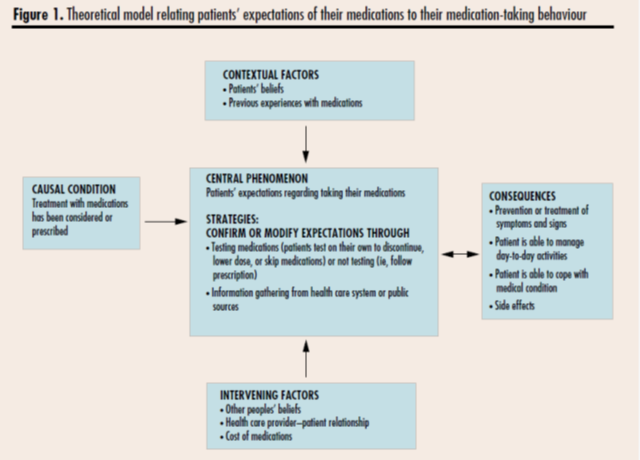
Patients’ expectations were more realistic than idealistic. Many participants acted on their expectations by changing their medication regimens on their own or by seeking additional information on their medications. Expectations were affected by patients’ beliefs, past experiences with medications, relationships with their health care providers, other people’s beliefs, and the cost of medication. Patients actively engaged in strategies to confirm or modify their expectations of their medications.

<CONCLUSION>
A range of factors (most notably past experiences with medications and relationships with
health care providers) influenced patients’ expectations of their medications. More comprehensive discussion between patients and their health care providers about these factors could affect whether medications are used optimally.

120604

【開催日】
2012年4月25日

頭部外傷とADHDの関係

【文献名】
著者名:Heather T Keenan et al. 
文献タイトル:Early head injury and attention deficit hyperactivity disorder: retrospective cohort study.
雑誌名・書籍名:BMJ 2008: 337 doi: 10.1136/bmj.a1984 .
発行年:Published 6 November 2008.

【要約】
<Objective> 
To explore the hypothesis that medically attended head injury in young children may be causal in the later development of attention deficit hyperactivity disorder (ADHD).

<Design>
Retrospective cohort study.

<Setting>
Health improvement network database (1988-2003), a longitudinal UK general practice dataset.
Participants All children registered in the database from birth until their 10th birthday.

<Main outcome measures> 
Risk of a child with a head injury before age 2 developing attention deficit hyperactivity disorder before age 10 compared with children with a burn injury before age 2 and children with neither a burn nor a head injury.

<Results>
Of the 62?088 children who comprised the cohort, 2782 (4.5%) had a head injury and 1116 (1.8%) had a burn injury. The risk of diagnosis of attention deficit hyperactivity disorder before 10 years of age after adjustment for sex, prematurity, socioeconomic status, and practice identification number was similar in the head injury (relative risk 1.9, 95% confidence interval 1.5 to 2.5) and burn injury groups (1.7, 1.2 to 2.5) compared with all other children.

開催日】
2012年5月2日

高齢者をケアするということ

【文献名】
 
著者名:Richchard J. Ham et al.
文献タイトル:Primary Care Geriatrics.
雑誌名・書籍名:5th Ed. MOSBY.
発行年:2007.

【要約】
Chapter1 Caring for Older Patients and an Aging Population

<OBJECTIVES>
・Describe the demographic changes resulting from the ageing population of US (Japan)
・Explain how demographic changes occurring among rural population, minorities, and women will affect health care.
・Discuss primary care as it pertains geriatrics
・Describe two features that make up the foundation of geriatrics medicine
・Describe the newest trends and programs in geriatric care 

<POPURATION DEMOGRAPHICS>
 In 2003, nearly 36 million people age 65 and over live in the US
  Women make up 58% of those over age 65 and almost 70% of those over 85
  A common myth in America is that older people are “dumped” into nursing home

<RURAL ELDERS>
Rural elderly living on farms are more likely than urban elderly to be married and living with their spouse.
 These limitations affect rural elder’s use of health care services, especially owing to limited access to health maintenance visits and prevent care.

<ECONOMICS OF AGING>
 Social Security income has provided the largest share of income for older Americans since the early 1960s

<DEMOGRAPHY AS IT AFFECTS HEALTH CARE>
 Childhood mortality has been significantly reduced 
 Changes in public health
 Changes of Causes of death (1940s;infections,trauma→Now; chronic disease )

<CHANGES IN LONG-TERM CARE AND THE INFLUENCE OF THE BABY BOOMERS>
 One of the greatest shifts in long-term care culture is currently within the nursing home setting.

<PROVIDERS OF GERIATRIC CARE>
 All clinicians see older persons
 All health care providers to have substantial geriatrics training 

<PRIMARY CARE>
 Successful primary care for the frail/complex older adult is based both on a special knowledge set and on a philosophy of care.

 -Geriatrics as a Philosophy of Care-
  Treatment decisions should be evaluated in terms of the potential benefit of enhancing or maintaining function versus the potential risk of causing a loss independence

 -Ethical Decision Making-
  There is much that we can do in medicine, but key question in geriatric care is what we should do.
  Geriatric clinicians need to be aware of their own values toward disease and disability
-Patient-centered care-
  The clinician can utilize the questions in the acronym FIFE to explore the meaning and impact of changes in the patient’s life

<RECOGNIZING AND AVOIDING AGEISM>
  Ageism refers to the unfair judging of elderly adults simply because of their advanced age
  This stereotype can be so prevalent in society that it is almost invisible, but it can perpetuate negative behavior.

<FUTURE TRENDS>
 -Collaborative Practice-
  Effective care of the older adults in highlighted by collaboration between multiple health care providers

-Prevent Care-
  Research has shown that health promotion and disease prevention activities are beneficial in any age 
 -Chronic Disease Self-Management-
 -Special Programs for Organizing, Funding, and Providing Geriatric Care-
・the complexity involved in providing comprehensive geriatrics care has led to the development of number of special programs to improve quality and reduce risks.
 -Program of all-inclusive care of the elderly-
・The example of a managed capitates approach to improving the care for the frail elderly the Program of all-inclusive care of the elderly(PACE)….The two cost medical care components are hospital and nursing home care…PACE program are able to expand the range of covered service

<SUMMARY>
 The aging population will mean that all primary care clinicians will spread a significant portion of their time providing care to older persons.
 Clinicians must be aware that “Older persons” is very diverse and each patients likely to present with special needs and challenges.
 Geriatric care involves both a specific knowledge base and a particular approach to problems.
 The foundation of that approach is attention to the patient’s function capabilities and an appreciation for the ethical questions that underline all medical decisions.
 Because of complexity involved in caring for this diverse population, interdisciplinary teams and special programs are often necessary. 

【開催日】
2012年4月18日

緩和ケアのアップデート

【文献名】
著者名:Keith M. Swetz, et al.
文献タイトル:In the Clinic: Palliative Care. 
雑誌名・書籍名:Annals of Internal Medicine: page ITC2-2~ITC2-16
発行年:2012.

【要約】

<緩和ケア vs. ホスピス>
緩和ケアとホスピスは関連しているが、はっきりと区別できる緩和医療の形である。これらは同義ではなく、今にも亡くなろうとしている患者のためだけに用意されるべきものではない。緩和ケアは深刻な病気を抱えた患者における症状の管理、QOL、治療の目標を描くことに焦点をあてるが、その一方で、目標が治療であれば、延命やQOL・機能の最大化に焦点を当てる。ホスピスは緩和ケアの特殊な型であり、予後が半年以内の方を対象にしている。重症な患者はすべて、治療目標を明らかにして症状の評価や管理をすべきである。治療目標が不明瞭なままで、症状の管理が難しいようであれば、緩和ケアの専門医への紹介が求められる。

・緩和ケアはホスピスとどのように違うのか?
・患者が緩和ケアを受ける時、どのような治療が禁止または許容されるのか?
・大半の保険によりどのように緩和ケアの費用が支払われ、またホスピスとはどのように違うのか?
・非常に重篤な患者における予後や生存予測にはどのようなツールがあるか?
・緩和ケアチームに不可欠なのは誰か?

<良くある症状の管理>
中等~重度の痛みは、とりわけ癌において、オピオイドで管理するのが最も良い。呼吸困難もまたオピオイドで治療することが効果的である。この両者の状況で、適切にモニターされ、選択され、用量調整されたオピオイドは、呼吸抑制に関しての重大な危険性がなく使用できる。想定される関係した神経伝達物質を個々の状況に合わせたとき、嘔気の治療は最も効果的である。不安は患者にとって解決が難しいものであるが、薬物的治療を開始する前に身体的あるいは非身体的なストレスの引き金になっているものを探索すべきである。終末期の事例におけるせん妄は一般的でかつ悩ましいが、早期に認識してベンゾジアゼピンより精神安定剤で治療すべきである。抑うつは重い病いの正常な部分ではなく、症状が持続するときは精神刺激薬あるいはSSRIでの治療が、たとえ終末期の状況においても求められる。拒食症や悪液質は多因子の神経ホルモンの作用であり、経口摂取を勧める努力は、患者の癒しや楽しみのために、中心静脈や経腸の栄養よりも、特に病気の末期では優先されるべきである。

・痛みはどのように評価し管理されるべきか?
・オピオイドの副作用はどのように管理すべきか?
・特定の原因による痛みにおいてどのような追加処置を考慮すべきか?
・呼吸困難の緩和のためにはどのような治療が効果的か?
・吐き気を訴える患者にどのように制吐剤を選択すべきか?
・興奮や悲嘆をどのように評価し治療すべきか?
・重病患者におけるせん妄の管理はどのようにすべきか?
・うつは重い病いの正常な部分であるのか?そしていつ治療されるべきか?
・重症患者における拒食症の治療について、ケア提供者はいつ、どのようにアプローチすべきか?
・人工栄養や補液は患者の症状を緩和し、生命予後を改善するか?

<コミュニケーション、心理社会的、倫理的な課題>
ケアの目標や病気が進行した時に何を期待するかに関して、早期に、定期的な議論を医師、患者、家族の間で行うことは、重要であり、目標を設定する助けになり、希望を維持するのに役立つ。事前のケア計画や意思決定のための代理人としての潜在的な役割について議論することは重要である。治療の負担がその利益よりも大きくなると気付いたとしたら、その治療を取りやめることは、治療を決して始めないことと道徳的に同等である。

・臨床医は終末期の議論にどのようにアプローチすべきか?
・臨床医は事前指示を含めた、事前のケアの計画をどのように援助することが出来るか?
・生命を維持する治療をさし控えたり、撤回することと安楽死または自殺補助の間にある法的で倫理的な違いは何か?
・緩和的な鎮静は今までにも容認可能であったか?

<患者教育>
・緩和ケアに関して患者とその家族は何を知るべきか?
・緩和ケアに関して議論するには、いつが最も良い機会であるか?

<診療の質の改善>
・緩和ケアの質を評価するために、米国の利害関係者はどのような指標を使用しているか?
The Hospice PEACE set ; http://www.thecarolinascenter.org/default.aspx?pageid=46 
Covering all 8 domains of palliative care quality 
1. Structure and Process of Care
2. Physical Aspects of Care
3. Psychological and Psychiatric Aspects of Care,
4. Social Aspects of Care
5. Spiritual, Religious, and Existential Aspects of Care
6. Cultural Aspects of Care
7. Care of the Imminently Dying Patient
8. Ethical and Legal Aspects of Care
・緩和ケアの提供に関して専門組織は何を推奨しているか?
 The Center to Advance Palliative Care
 The Carolinas Center for Medical Excellence
 The :American College of Pysicians

<ツールキット>
PIER Modules, Patient Information, General Information.

<患者用情報>
・緩和とはどういう意味か?緩和ケアとは何か?
・緩和ケアの専門家は何をするのか?
・緩和ケアはホスピスと同じか?
・緩和ケアが助けになるかも知れない状況

【考察とディスカッション】
In The ClinicはUpToDateやDynamedと同様に、エビデンスに則った症候の総まとめに有用な2次文献資料であると感じた。症状や倫理的な問題への対応については、その他の文献や教科書でも載っている内容であり、目新しいものはないものの、プライマリケアの現場ですぐに使いやすい形でコンパクトにまとめられている印象である。たとえば、末期の胃がんの患者で「いらいら」で悩んだ事例が最近あり、その解決法が「興奮や悲嘆をどのように評価し治療すべきか?」の項目に記載されていて参考になった。このように、Q&A形式で臨床において重要なポイントを取り扱っており、大変勉強になる。(ちなみに皆さんは文献として何を参考に緩和ケア、終末期ケアを行っているでしょうか?)
また、日本語版のイン・ザ・クリニックhttp://www.amazon.co.jp/イン・ザ・クリニック–診療現場ですぐに役立つエビデンス–竹本-毅/dp/4895926958/ref=sr_1_1?ie=UTF8&qid=1335305467を参照すると、糖尿病、うつ病、心不全などの良く遭遇する臨床状況において、「診断」や「治療」のみならず、「スクリーニングと予防」「患者教育」、「診療の質の改善」、「患者用情報」という項目が、どのテーマでもある程度の共通した項目として挙げられており、今後、患者や家族とそのテーマについて話し合ったり、現在の自分の診療を振り返ったり、診療所でQI活動を行ったりする際に有用である。今回のテーマでいえば、診療の質改善の項目として、the Hospice PEACE set‐参考1)について、NICEのガイドライン‐参考2)と比較しながら診療所で取り組むことも一案である。
特に「診療改善」の項目については取り扱われるテーマによってはNICEよりも簡潔にまとまっているものもあり、各診療所における今後のCQIプロジェクトにおいての助けになると思われる。

120604_1

120604_2

【開催日】
2012年4月25日

OABに対する抗ムスカリン薬

【文献】
著者名:Dudley Robinson, Linda Cardozo.
文献タイトル:Antimuscarinic drugs to treat overactive bladder. 
雑誌名・書籍名:BMJ 2012;344:e2130 doi: 10.1136/bmj.e2130.
発行年:Published 27 March 2012

【要約】
<OABとは>
尿意切迫を起こす症候群の総称。通常頻尿を伴う。尿失禁の有無は問わない。また、尿路感染症や他の明らかな病因を伴わない。原因は不明(排尿筋や副交感神経に原因があると考えられている)。

<抗ムスカリン薬の効果>
・抗ムスカリン薬に有効性あり
 ①systematic review: 32のRCT(計6800名): 治癒または改善効果 RR 1.41, 95%CI 1.29-1.54
 ②Cochrane review: 61のRCT(計11956名): 治癒または改善効果 RR 1.39, 95%CI 1.28-1.51, NNT 7
 ③最新のsystematic review: 83のRCT(計30699名, 6種類の異なる薬剤):
・排尿コントロール可能…RR 1.3-3.5
・失禁回数…0.4-1.1回減少, 排尿回数…0.5-1.3回減少, 尿意切迫…0.64-1.56回減少
・各薬剤間の効果を比較したevidenceには乏しい

<抗ムスカリン薬の安全性>
副作用:口渇・便秘・かすみ目・眠気・認知能障害・QT延長
 ①systematic review : 149の論文: 内服開始後30日以内に43-83%が中断
 ②meta-analysis: prospective randomized trials:
・CNSへの影響を調査。事故を報告した研究は少ない
・最も多いのはめまい(oxybutynin 3%, propiderine 3.2%, tolterodine 1.8%, placebo 1.6%)

<副作用の予防策>
・高齢者:起立性低血圧や認知障害のリスクが高いため、少量投与
・排尿障害:男性はその増悪を考慮, 女性はまれ。そのため、ルーチンの残尿モニターは不要

<費用対効果>
・UK National Health Serviceの評価:solifenacinが最もQALYが高かった

<内服法やその後のモニター>
・内服開始前に充分にその副作用や内服以外の方法(Tips for patients下に記載)について話し合うこと
・一般に少量から開始し、効果や副作用を見ながら調整すること
・肝機能・腎機能障害の患者さんに肝腎機能のモニターは不要

<保存的療法や他の薬剤との比較>
1.保存的療法との比較:
Cochrane review: 13の研究(計1770名): 
・症状改善効果…抗ムスカリン薬 vs 膀胱トレーニング RR 0.73, 95%CI 0.59-0.90
・症状改善効果…抗ムスカリン薬+膀胱トレーニング vs 抗ムスカリン薬 RR 0.55(0.32-0.93)
2.他の薬剤:
vasopressin analogue:Table1
 ・夜間頻尿や夜尿症には第一選択(抗ムスカリン薬との直接比較なし)

Tips for patients
Overactive bladder is a common and distressing condition?Bladder retraining, lifestyle advice, and pelvic floor exercises should help to improve the symptoms of overactive bladder
Think about fluid intake and try to avoid caffeinated drinks, artificially sweetened carbonated drinks, and alcohol. Try not to drink too much (generally no more than 1.5 litres a day), and limit your fluid intake before bed
Your local continence advisory service will be able to provide you with tips for coping strategies and advice about containment products such as continence pads
Antimuscarinic drugs may be useful in addition to conservative measures when trying to control your bladder symptoms; these may be required long term as overactive bladder is a chronic condition
Antimuscarinic drugs may be associated with a dry mouth. Try sucking a sweet or chewing gum to increase salivation Constipation may also be associated with taking antimuscarinic drugs: it may be necessary to alter your diet or consider laxatives

【開催日】
2012年4月18日

COPC、地域コミュニティケアの研修プログラムをしっかり評価していきましょう!

【文献】

著者名:Alison Dobbie,MD.et al.
文献タイトル:Evaluating Family Medicine Residency COPC programs Meeting the challenge.
雑誌名・書籍名:Fam Med 2006
発行年:38(6):399-407.

【要約】

<Background and Objectives>
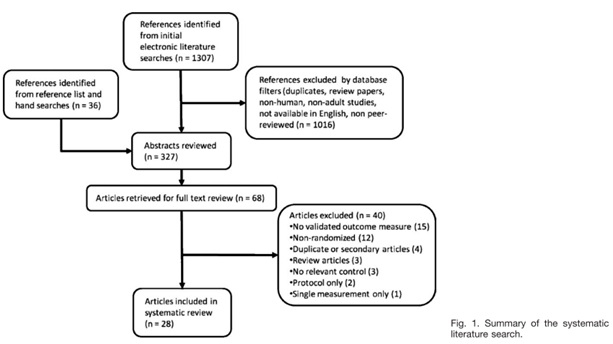
We conducted a review of the evaluation literature and outcomes from community-oriented primary care (COPC) programs in US family medicine residencies since 1969.

<Methods>
We used a Medline and ERIC search for “community-oriented primary care” in English from 1969-2005. 

<Results>
Twenty-two articles were found that concerned US family medicine residency COPC. Selection process describes in table1.Finnaly, Eight descriptive and eight evaluative papers described 14 residency COPC programs. Teaching and learning methods included block and longitudinal rotations and COPC projects. Evaluation methodologies included one quasi-experimental control group study, pretests and posttests of knowledge and attitudes, focus groups, and semi-structured interviews. Reported outcomes included changes in residents’ knowledge, attitudes, and behaviors; effect on graduates’ career choice and future practice; and impact on patient care and community health. 

<Conclusions>
 Few studies have evaluated residency COPC programs. Evaluation has been less than rigorous, with variable results, but at least one study indicates positive outcomes at each evaluation level. More residency programs must evaluate and disseminate outcomes from their COPC projects to determine the value of COPC to residents, colleagues, community partners, and funding agencies.

<Recommendations–Designing a COPC Evaluation Plan>
We recommend that faculty design their evaluation plan before implementing any residency COPC project, because data are more difficult to gather after the event, and the opportunity to gather baseline data is lost. We recommend that faculty design a plan addressing all four of Kirkpatrick’s levels of evaluation, as demonstrated in Table 2.

Level 1 data (reaction) measure course process outcomes, such as whether residents enjoy the learning experience, believe the content and teaching methods to be appropriate and well taught, report the program to be well organized and efficient, and consider it a useful contribution to their training. 

Level 2 data (learning) describe changes in residents’ COPC knowledge and attitudes. In 1999, Oandesan validated a 20-item survey that can serve as a pretest and posttest of residents’ attitudes to COPC. Donsky published a COPC questionnaire in 1998 that can be used as a pretest and posttest of knowledge and attitudes, although this instrument has not yet been validated. Qualitative methods for evaluating learning include focus groups, semi-structured interviews, written case exercises, and reflective essays and journals.

Level 3 data (transfer) concern changes in residents’ behavior and/or clinical practice. Behavior change can be measured through direct observational studies, chart reviews, electronic health record searches, and/or selfreports in written or electronic surveys. Self-reported changes in behavior represent much weaker types of Level 3 data than objective measures such as direct observation or chart review. 

Examples of Level 4 data (results and outcomes) include changes in graduates’ clinical practice resulting from the COPC projects, permanent adoption of the COPC program into the residency curriculum, and measurable effects on community agencies or practice populations. The effect of the COPC program on graduates’ practice behavior can be measured by telephone, electronic, or mailed surveys 1 to 2 years
after residency. Effects on community agencies can be measured by semi-structured interviews or focused group.

120426

【開催日】
2012年4月26日

組織管理

【文献名】

Quint Studer著、エクセレント・ホスピタル、ディスカバー社、2011年

【要約】

<5つの柱、9つの原則で最高の組織を目指す>
5つの柱とは「医療の質」、「サービス」、「人材」、「成長」、「財務」の柱である(※Balanced Score Cardの考え方に「人材」が加えられた形)。以下、一つ一つの原則について触れる。

1.最高の病院になることを決意する
5つの柱それぞれについて測定可能な指標を設定することから始まる。それぞれの目標を定め、行動計画を作成し、評価制度を設定すれば、職員は目標達成に主体的に関わるチャンスが生まれる。そのためにはa) 職員の意識を高めるため全ての会議の議題を「5つの柱」に合わせる、b) 責任感をもたせるためにリーダーの評価を「5つの柱」に合わせる、c) 指標の進捗状況を知らせるために「5つの柱」で表した部門間のコミュニケーションボードを作成する。サンプル指標を揚げる(図1)。

2.重要な指標を測定し、改善する
定めた指標はできるだけ頻繁に測定する。一般に四半期では不十分。モチベーションを保つためには少しでも早く成果を知る必要がある。

3.サービス志向の文化をつくる
いくつかのサービスチームを作ることが原動力になる。標準化チーム、患者満足度チーム、職員満足度チーム、測定チーム、コミュニケーションチーム、評価・報酬チームなど。職員が主体的に関わる。

4.リーダーを育成する
リーダーシップを学んでいる職員が不在ではいけない。リーダーシップ開発セミナーを行うべきである。部門管理者も医療ファイナンス、業務量管理、パフォーマンス別面談スキル、上司をコントロールスキル、測定結果からアクションプランを立てるスキルなどを育成する必要がある。特に、「組織変革の壁」を学ばせ予測・対応できる能力の育成が必要。組織の成長段階の中で必ず職員のパフォーマンスのばらつきが生じ、パフォーマンスに応じた対応が組織改善に必要。

5.職員の満足度に重点を置く
この原則に重点を置くことは全ての柱の改善につながる(※参考:Service-Profit Chain)。リーダーへのフィードバックはリーダーのトレーニングにもなる(図2)。改善すべき課題は「90日間行動計画」に落とし込む。

6.職員一人一人に責任感をもたせる
「名案プログラム」を導入する。自分の案が組織改善に寄与し、評価されるならば、職員は主体的に組織改善に関わるチャンスがある。

7.個人の行動を、組織のゴール・価値観に合致させる
組織の目標に合わせてリーダーを評価する(図3)。ペースメーカーとして月齢進捗報告書(図4)、90日間行動計画(図5)なども利用する。また、医療者同志での評価も取り入れる(図6)。

8.すべての職員とコミュニケーションをとる
職員フォーラムやコミュニケーションボードの活用で一人一人の行動に影響する。

9.成功を認め、讃える
「感謝の手紙」などで職員を評価する。

図1
120426_1

図2
120426_2

図3
120426_3

図4
120426_4

図5
120426_5

図6
120426_6

【開催日】
20120年4月11日

医療の質の第3軸「ケアの経験」を改善する~英国NICEガイダンスのサマリーより~

【文献名】

著者名:O’Flynn N, Staniszewska S et al. 
文献タイトル:Improving the experience of care for people using NHSserveices; summary of NICE guidance. 
雑誌名・書籍名:BMJ.
発行年:10.1136/bmj.d6422.

【要約】

The emphasis in healthcare has often been on clinical efficacy and outcomes, which can come at the expense of the patient’s experience. Developments in healthcare delivery can make giving attention to the individual more difficult, especially as healthcare has become more technological and specialised, increasing the number of people and services that a patient has contact with. Changes in the working practices of healthcare staff (such as more part time working) and the rise in the number of large institutions delivering care can mean that patients have less opportunity to develop relationships with professionals who treat them and are more likely to be treated by a team.
The NHS “next stage” review, a review commissioned to develop a vision of an NHS fit for the 21st century, recognised the experience of patients as one of three dimensions of quality.1 The other two dimensions were clinical effectiveness and safety.

<Essential requirements of care>
・Do not discuss the patient in their presence without involving them in the discussion.
・Be prepared to raise sensitive issues (such as sexual activity, continence care, and end of life) as these will not be raised by some patients.
・Ensure that the patient’s nutrition and hydration are adequate at all times (when they are unable to manage this themselves) by:

Providing regular food and fluid of adequate quantity and quality in an environment conducive to eatingPlacing food and drink where the patient can reach them easily
Encouraging and helping the patient to eat and drink if needed
Providing appropriate support, such as modified eating aids and/or drinking aids.
・Ensure that the patient’s pain relief is adequate at all times when they are unable to manage their own analgesia by: Not assuming that the patient’s pain relief is adequate
Asking the patient regularly about pain

Assessing pain using a pain scale if necessary 
Providing pain relief regularly and adjusting as needed.
・When the patient is unable to manage their own personal needs (for example, relating to continence, personal hygiene, and comfort), inquire regularly and try to meet such needs at the time of asking. Ensure maximum privacy.

<Shared decision making>
・When trying to reach a shared decision on investigations and treatment, discuss the matter in a style and manner that enables the patient to express their personal needs and preferences. 
・Give the patient the opportunity to discuss their diagnosis, prognosis, and treatment. 
・Before starting any investigations or treatment: Explain the medical aims of the proposed care 
Openly discuss and provide information about the risks, benefits, and consequences of the investigation or treatment (taking into account factors such as coexisting conditions and the patient’s preferences) 

Set aside adequate time to allow any questions to be answered, and ask the patient if they would like a further consultation. 
・Clarify what the patient hopes the treatment will achieve and discuss any misconceptions.
・Give the patient, and their family members and/or carers if appropriate, adequate time to decide whether they wish to have investigations and/or treatment. 
・Accept and acknowledge that patients may vary in their views about the balance of risks, benefits, and side effects of treatments. 
・Use the following principles when discussing risks and benefits with a patient:
Personalise risks and benefits as far as possible.. 

Use absolute risk rather than relative risk–for example, the risk of an event increases from 1 in 1000 to 2 in 1000, rather than the risk of the event doubles. 

Use natural frequency rather than a percentage–for example, 10 in 100 (better still, 1 in 10) rather than 10%. 

Be consistent in the use of data–for example, use the same denominator when comparing risk: 7 in 100 for one risk and 20 in 100 for another, rather than 1 in 14 and 1 in 5 
.
Present a risk over a defined period of time (months or years) if appropriate–for example, if 100 people are treated for 1 year, 10 will experience a given side effect. 

Include both positive and negative framing–for example, treatment will be successful for 97 out of 100 patients and unsuccessful for 3 out of 100 patients. 

People differ in the way they interpret terms such as rare, unusual, and common, so use numerical data if available. 

Consider using a mixture of numerical and pictorial formats–for example, numerical rates and pictograms (such as figures 1 and 2). 
・Offer support to the patient when they are considering options. Use the principles of shared decision making: Ensure that the patient is aware of the options available, and explain the risks, benefits, and consequences of these.
Check that the patient understands the information.
Encourage the patient to clarify what is important to them, and check that their choice is consistent with this.
・Be aware of the value and availability of patient based decision aids. If suitable high quality decision aids are available, offer the most appropriate one to the patient.

<Tailoring healthcare services to the patient>
・At intervals agreed with the patient, review their knowledge, understanding, and concerns about their condition and treatments, and their view of their need for treatment, as these may change over time. Offer the patient repeat information and review, especially when treating a long term condition. 
・Tailor healthcare services to the patient’s needs and circumstances, taking into account locality, access, personal preferences, and coexisting conditions. Review the patient’s needs and circumstances regularly. 
・Give the patient information about relevant and available treatment options even if these are not provided locally. 
・Tell the patient about available health and social services (such as smoking cessation services) and encourage them to access these according to their individual needs. 
・Ensure that discussions are held in a way that allows the patient to express their personal needs and preferences for care. Allow adequate time so that discussions do not feel rushed. 
・Clarify with the patient at the outset whether and how they would like their spouse, partner, family members, and/or carers to be involved in key decisions about the management of their condition. 
・Accept that the patient may have different views from healthcare professionals about the balance of risks, benefits, and consequences of treatments. 
・Accept that the patient has the right to decide not to have a treatment (even if you do not agree with the decision) as long as he or she has the capacity to make an informed decision and has been given the information needed to do this. 
・Inform the patient that they have a right to a second opinion.
・Respect and support the patient in their choice of treatment or decision to decline treatment. 
・When patients in hospital are taking medicines for long term conditions, consider and discuss with them whether they are able to, and would prefer to, manage these medicines themselves. 

<Continuity of care>
・Consider each patient’s requirement for continuity of care and how that requirement will be met. This may involve the patient seeing the same healthcare professional throughout a single episode of care or ensuring continuity within a healthcare team. 
・Inform the patient about:
Who is responsible for their care and treatment 
The roles and responsibilities of the different members of the healthcare team 
The communication that takes place between members of the healthcare team. 
・Give the patient (and their family members and/or carers if appropriate) information about what to do and whom to contact in different situations, such as “out of hours” or in an emergency. 
・For patients who need several different services, ensure effective coordination and prioritisation of care to minimise the impact on the patient. 
・Ensure clear and timely exchange of patient information between healthcare professional teams and other agencies–for example, transitions of care including discharge. 

120426_7

Fig 1 Personalised pictogram and bar chart based on high quality predictive models showing that of 100 patients with particular clinical characteristics 49 will experience a cardiovascular event (such as a heart attack or stroke) over the next 10 years. Adapted with permission from the Institute of Health and Society, Newcastle University

120426_8

Fig 2 Personalised pictogram and bar chart showing the likely reduction in risk of cardiovascular events after stopping smoking, reduced from 49 in 100 to 31 in 100. Adapted with permission from the Institute of Health and Society, Newcastle University

【開催日】
2012年4月4日

プライマリケア医の肺癌スクリーニング診療:全国調査の結果より

【文献名】

著者名:Klabunde CN, Marcus PM, et al.
文献タイトル:Lung Cancer Screening Practice of Primary Care Physicians: Results From a National Survey. 
雑誌名・書籍名:Ann Fam Med.
発行年:2012;10(2):102-110.

【要約】

<目的>
現在の診療ガイドラインは無症候の患者に対する肺癌スクリーニングを勧めていないが、いまだ肺癌スクリーニング検査を指示する医師がいる。健康専門職に対する最近の全国調査の中では肺癌スクリーニングに焦点当てたものはない。この研究では、米国のプライマリケア医の肺癌スクリーニング診療と同時に、肺癌スクリーニング検査を指示する医師の特性を調査した。

<方法>
2006~2007年にプライマリケア医全国抽出調査を実施した。郵送された質問紙にて、肺癌スクリーニングガイドラインへの医師の知識、スクリーニング検査の効果に対する信頼感、そして過去12ヶ月の胸部X線、低線量スパイラルCT、喀痰細胞診の指示数を調査した。また、臨床Vignetteを用いて、無症候だが肺癌に対して異なる喫煙歴を持つ50歳の患者に対するスクリーニングの意志を評価した。

<結果>
全962名の家庭医、GP、総合内科医が質問紙に回答した。(協力率76.8%)全体では、38%の医師が肺癌スクリーニング検査を指示せず、55%が胸部X線を指示し、22%が低線量スパイラルCT、5%以下が喀痰細胞診を指示した。多変量モデルにおいては、専門家グループが肺癌スクリーニングを推奨していると信じている、またはスクリーニング検査が効果的だと信じていればいるほど、プライマリケア医には肺癌スクリーニング検査を指示する傾向が見られていた。他にも、相当量の喫煙曝露のない患者も含んだ無症状患者に対するスクリーニングを勧める傾向が強ければ指示しやすく、患者がスクリーニングを依頼する傾向があれば指示しやすかった。

<結論>
米国のプライマリケア医は、専門家グループが推奨しないにもかかわらず、無症状患者に対して肺癌スクリーニング検査を頻繁に指示する。プライマリケア医と患者は肺癌スクリーニングに関するエビデンスの基盤、ガイドライン、潜在的な危険性、そして不適切な指示に伴うコストに関する情報をより多く得る必要がある。

【開催日】
2012年4月4日

日常病・日常的健康問題

【文献名】

山田隆司、吉村学、名郷直樹ら:日常病・日常的健康問題とは–ICPC(プライマリ・ケア国際分類)を用いた診療統計から(第1報)–.プライマリ・ケア:P80−89, Vol.23 No.1 2000

【要約】

<はじめに>
プライマリ・ケアの現場である地域の第一線の医療機関には、様々な健康問題を持った患者が日々訪れる。そこでは患者の医療ニーズに沿った医療の提供が望まれる。プライマリ・ケアの現場では、極めて病初期の患者や多臓器にわたる疾病を同時に抱える患者、病因となる臓器を特定しかねる患者等、一概に臓器別の診療の提供をすれば事が済む患者はむしろ例外的で患者に身近な設定であればあるほど幅広い臨床能力が求められる。最も身近な家庭医、プライマリ・ケア医に地域住民は何を求めているのか、いわゆる地域住民の日常的健康問題、日常病を知る事がプライマリ・ケアを論ずる上での出発点と言える。今回、我々は、地域に単独で存在する、いわゆる僻地診療所の受診患者および往診の要請があった患者、すべての受診理由、診断病名、診療行為等をICPC(プライマリ・ケア国際分類)に則り分類し、1年間にわたって記録、統計解析したので報告する。

<方法>
今回の調査に参加した医療機関は岐阜県久瀬村診療所、春日村診療所、藤橋村診療所、愛知県作手村診療所、愛媛県二名津診療所の5診療所で、いずれも僻地に存在し、地域の唯一の医療機関としてプライマリ・ケア機能を担っている。
  調査研究に参加した7人の医師は、あらかじめICPCに関する勉強会、研修会に参加し、医師間での誤差をなくすように検討した。
  5診療所にあらかじめ、アムステルダム大学家庭医療学講座が開発し、自治医大地域医療学講座が一部修正を加えたコンピューターソフトを導入し、1年間のすべての外来受診患者について、その受診理由、診断病名、診療行為を記録した。
  記録した事項は(1)受診理由:症状や愁訴等、患者が自発的に述べた健康問題をコード分類化し2項目記録、統計資料として保存する受診理由は1番目の愁訴、症状を主訴として記録、(2)診療要求:再診時等で症状や愁訴が特にない場合は何を求めて来院したかを記録、(3)病歴、(4)診断前介入行為、(5)診断病名:当日診断した健康問題の診断病名、診断不可能な場合は主訴、(6)健康問題の新旧の区別:受診当日の新しい健康問題か、以前から継続した健康問題か、(7)旧診断病名:同一の健康問題でその病名が変更された場合の以前の病名、(8)確定診断か否か、(9)診断後介入行為、(10)紹介の有無
  上記の項目を1回の受診につき、健康問題毎に記録した。

<ICPC>
プライマリ・ケアの現場での有効で利便性の高いデータ収集を目的にWONCA分類委員会が開発したもの。特徴は病名分類の項目をプライマリ・ケアの現場で遭遇する頻度に沿って少なくした事、診断病名がつかない時は、症状、愁訴で病名として扱う事、必要に応じて国際疾病分類(ICD)に変換できるよう対比表を完備したこと、国際比較が可能なこと。

<結果>
1.受診回数
 1997年4月1日から1998年3月31日の1年間に、5診療所を少なくとも1回受診または往診した患者は全部で4495人。5診療所の対象人口は住民登録上8116人。およそ55%の人が1年に少なくとも1回は地元の医療機関を受診していることになる。各年齢層毎の受診状況は幼小児、高齢者に高い受診率が見られた(図1)
 全受診回数は総数43137回、受診者一人当たりの平均受診回数は1年間で9.6回。

2.健康問題
 延べ健康問題数は67499件で、1受診あたりの平均はおよそ1.6件。新しく記録された健康問題は10570件、既に有していた健康問題は3971件。初診といえる健康問題が10570件(延べ健康問題数の15.7%)、再診が56929件。
a)すでに有していた健康問題
内訳は表1。いわゆる慢性疾患がほとんどで、対象人口を母数にすると、おおよその有病率を推測できる。
b)新しく記録された健康問題
内訳は表2。年間の発症率を推測することができる。これらはいわゆる日常病と言われる発症頻度の高い疾病群である。
c.臓器別健康問題
内訳は図3。継続的な健康問題、新しい健康問題のいずれも幅広い臓器にわたって健康問題が日常的に見られている。

3.受診理由
 初診時の受診理由(表3)はそれぞれの健康問題のきっかけになるで日常的健康問題といわれるものである。多くの臓器に関与する症状であり、病初期に関与するプライマリ・ケア医にとって、最も重要な情報であり、適切に介入していくことが要求される。

<考察>
今回の調査で地域の第一線の医療機関に従事するプライマリ・ケア医の診療の概略を把握できた。プライマリ・ケア医の労力の多くは慢性疾患の管理に充てられ、内科的な疾患だけでなく老化と関連した多科の疾患、生活習慣病が多く、患者を取り巻く心理社会的背景を適切に理解しないと患者のQOL向上につながらない事が多く、患者に身近なプライマリ・ケア医がこれらを管理する事は意義深い。
  受診理由から、極めて多臓器に渡る愁訴で受診する患者が多く、これらに対して適切な診断技能、治療手技を身につけておく必要性が推測された。

【開催日】
2012年3月28日